
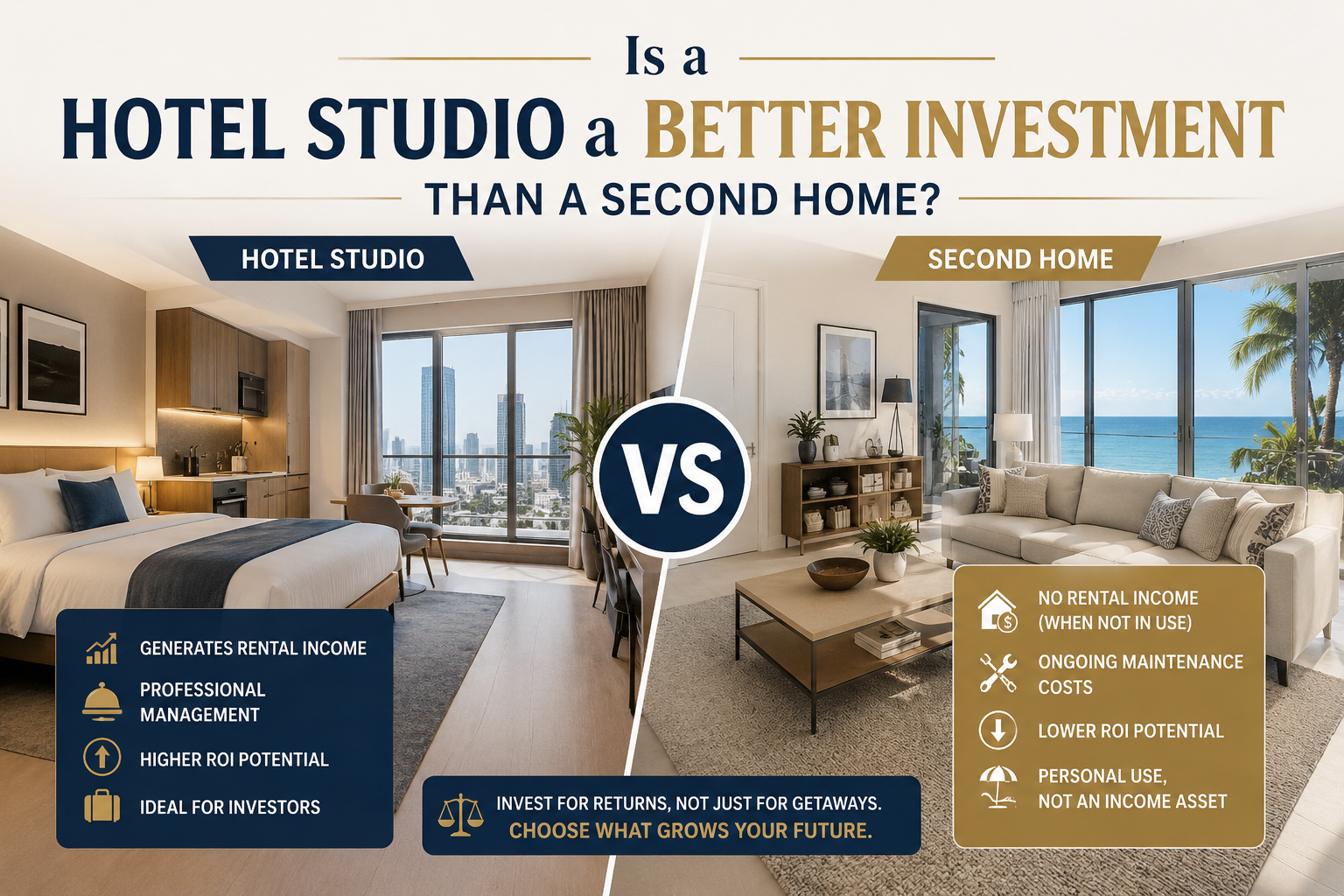
For many investors, buying a second home has traditionally been associated with owning a holiday property in a desirable destination. But as tourism grows and investor preferences evolve, managed hotel studios are emerging as an alternative worth considering.
So, is a hotel studio actually a better investment than a second home?
The answer depends on your objective—but when the goal is investment, income potential, and professional management, a hotel studio can offer some compelling advantages.
1. Second Home vs. Hotel Studio: The Basic Difference
A second home is primarily a residential property purchased for personal use, occasional stays, or rental income.
A hotel studio, on the other hand, is designed as part of a hospitality business. The property is professionally managed and operated for short-stay guests, with revenue generated through room bookings.
In simple terms:
Second Home = Property + Personal Use
Hotel Studio = Property + Hospitality Business
This difference can significantly affect how the asset is utilized.
2. Your Property Can Work Even When You’re Away
One of the biggest challenges with a second home is utilization.
You may visit it during holidays or weekends, but for much of the year, the property could remain unused. Renting it independently also means dealing with marketing, guests, maintenance, housekeeping, and tenant management.
With a managed hotel studio, these operational responsibilities can be handled by a professional hospitality operator.
That means the investor can own the asset without necessarily having to manage the day-to-day hotel operations.
3. Location Becomes More Important
A second home is often selected based on lifestyle preferences—peaceful surroundings, scenic views, connectivity, or proximity to attractions.
A hotel studio requires an additional consideration:
How strong is the tourism demand?
Destinations with consistent tourist footfall, attractions, events, and improving infrastructure can potentially create stronger demand for hospitality accommodation.
This is particularly relevant in tourism-driven destinations such as Jim Corbett, where leisure travel creates demand for hotels, resorts, and short-stay accommodation.
7
4. Professional Management Can Make a Difference
Owning a second home can come with several responsibilities:
Finding tenants or guests
Property maintenance
Housekeeping
Guest communication
Marketing
Repairs and upkeep
Managing bookings
A professionally managed hotel studio is structured around these hospitality operations.
The hotel operator typically takes care of the guest-facing side of the business, allowing the investor to take a more passive ownership approach.
5. Branding Can Add Another Layer of Value
A branded hotel can benefit from an established hospitality identity, operational standards, customer experience, and marketing ecosystem.
For investors, this can be an important consideration when comparing a professionally managed hotel studio with an independently owned holiday home.
However, investors should always evaluate the actual brand agreement, operator credentials, fee structure, revenue-sharing model, and exit terms before investing.
6. What About Returns?
This is where investors need to look beyond simple property appreciation.
A second home may generate rental income when occupied and may appreciate over time.
A hotel studio can potentially generate hospitality revenue based on room occupancy and operating performance, in addition to any future capital appreciation.
But there is an important point:
Hospitality income is not guaranteed.
Returns can depend on factors such as:
Occupancy
Room rates
Seasonality
Tourism demand
Operating expenses
Management fees
Revenue-sharing structure
Competition
Overall hotel performance
Therefore, investors should evaluate projected returns against realistic operating assumptions rather than relying only on advertised figures.
7. Which One Is Right for You?
The choice ultimately depends on what you want from the property.
Factor Second Home Hotel Studio
Personal Use High Usually Limited
Professional Management Usually No Usually Yes
Short-Stay Hospitality Limited Core Purpose
Rental Operations Owner-managed/outsourced Professionally managed
Income Potential Rental-based Hospitality-based
Maintenance Responsibility Owner Generally operator-managed
Investment Focus Lifestyle + Appreciation Income + Appreciation Potential
The Bottom Line
A second home can be an excellent choice if your primary objective is personal use, lifestyle, and long-term ownership.
But if your primary objective is to own an asset connected to a professionally managed hospitality business, a hotel studio may deserve serious consideration.
The key isn't simply asking:
“Which property should I buy?”
Instead, ask:
“What business model do I want my property to participate in?”
A well-located, professionally managed hotel studio can combine real estate ownership with hospitality operations, potentially giving investors an opportunity to participate in the growing tourism economy without managing a hotel themselves.
Before investing, always review the project approvals, operator agreement, management fees, ownership structure, revenue model, projected occupancy, and exit terms carefully.