
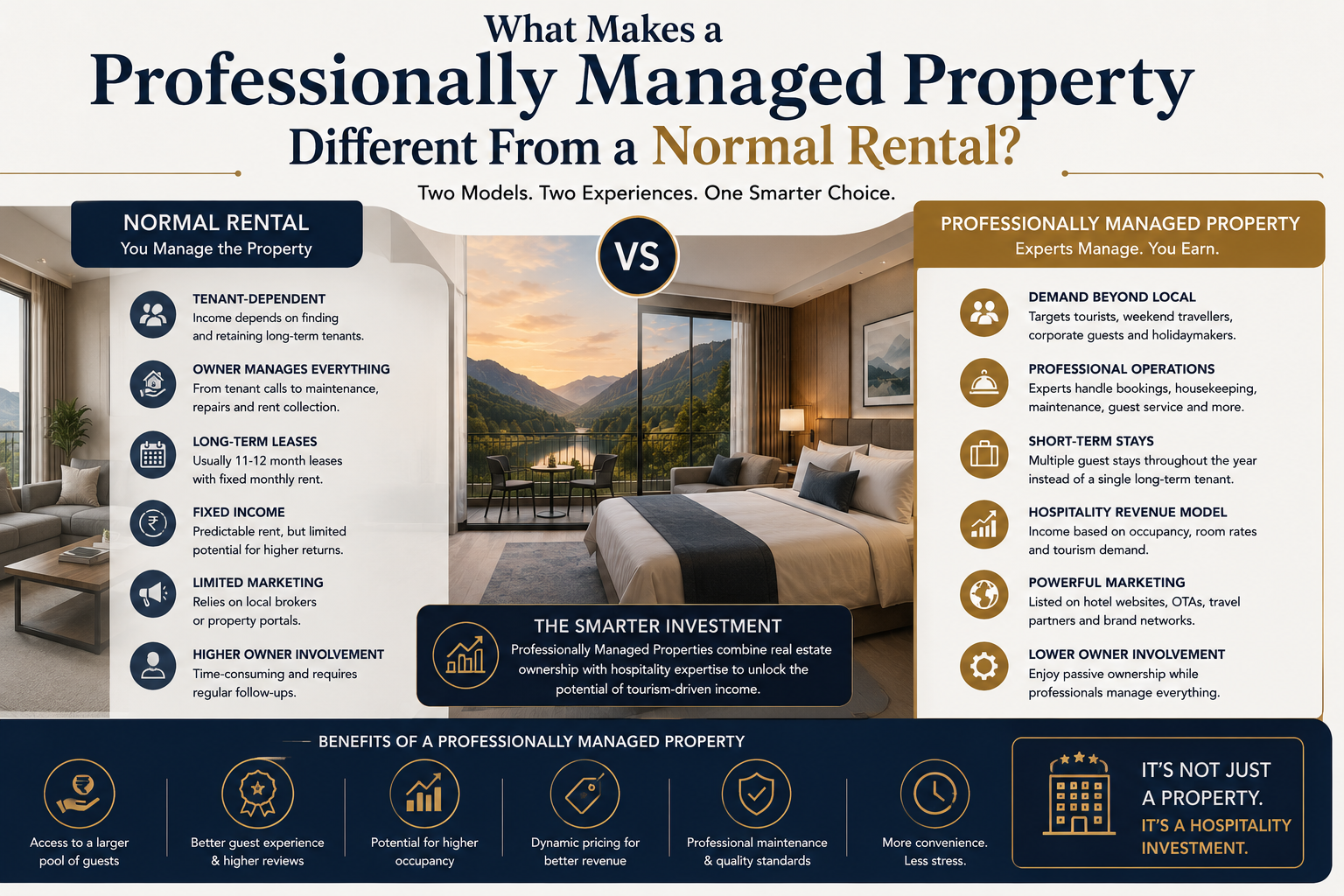
When people think about real estate investment, the traditional rental model usually comes to mind: buy a property, find a tenant, collect rent and manage the property yourself.
But the real estate market is evolving.
With the growth of tourism, short-term stays and professionally operated hospitality assets, managed properties and hotel studios are becoming an alternative for investors who want ownership without handling every operational responsibility themselves.
So, what exactly makes a professionally managed property different from a normal rental?
1. The Owner Doesn't Have to Become the Operator
In a traditional rental, the property owner is often responsible for finding tenants, handling maintenance requests, coordinating repairs and managing the property.
With a professionally managed property, these responsibilities can be handled by a dedicated management team, depending on the project's structure.
The owner can remain focused on the investment while professionals handle day-to-day operations.
Traditional Rental:
Owner → Tenant → Rent → Maintenance
Managed Property:
Owner → Professional Operator → Guests → Hospitality Revenue
This is one of the biggest differences between the two models.
2. Different Sources of Demand
A conventional residential rental generally depends on local rental demand.
Tenants may include working professionals, families or students who need accommodation for longer periods.
A managed hospitality property can instead target:
Tourists
Weekend travellers
Families on holiday
Corporate travellers
Destination visitors
Short-stay guests
This means the property's performance can be connected to tourism and hospitality demand, rather than only the local residential rental market.
3. Short-Term Hospitality vs Long-Term Renting
Traditional rentals generally involve longer lease periods.
Hospitality properties work on shorter stays, which means the property can potentially be rented multiple times throughout the year.
For example, instead of one tenant occupying a property for 12 months, a hotel studio could accommodate hundreds of guest stays over the same period.
However, this also means hospitality revenue can fluctuate with occupancy, seasonality, room pricing and tourist demand.
4. Professional Operations Make a Difference
A hotel isn't successful simply because it has attractive rooms.
It needs an operating system.
Professional management may take care of:
Booking management
Guest communication
Check-in and check-out
Housekeeping
Maintenance
Pricing
Marketing
Online travel platforms
Guest reviews
Customer service
For an individual investor, replicating all these functions independently can be time-consuming.
A professional operator brings systems, people and processes that are designed specifically for hospitality.
5. Guest Experience Becomes a Priority
In a traditional rental, the relationship is primarily between owner and tenant.
In hospitality, the guest experience becomes a core part of the business.
Clean rooms, quick service, comfortable facilities, smooth check-ins and positive reviews can influence future bookings.
This creates an important cycle:
Better Experience → Better Reviews → Greater Visibility → Potentially More Bookings
Of course, actual results depend on the property's location, operator, pricing and competition.
6. Marketing Is Different
A residential rental may be advertised through local brokers or property portals.
A professionally managed hospitality property can potentially be marketed through multiple channels, including hotel websites, online travel platforms, travel partners, social media and brand networks.
This broader distribution can help the property reach travellers beyond the local market.
7. Revenue Is Calculated Differently
One of the most important differences is the income model.
Traditional rental:
Monthly Rent − Expenses = Rental Income
Hospitality:
Room Rate × Occupancy × Available Days = Gross Room Revenue
The gross revenue generated by the property may then be distributed according to the project's revenue-sharing and operating structure after applicable expenses and fees.
Therefore, investors should never compare a residential rent figure directly with projected hotel revenue.
They are fundamentally different business models.
8. Management Fees and Operating Costs Matter
Professional management isn't free.
Depending on the project, investors may have to account for:
Management fees
Maintenance charges
Housekeeping expenses
Marketing costs
Utilities
Brand fees
Taxes
Other operating expenses
This is why investors should always ask for a clear net-income calculation, rather than focusing only on gross revenue or projected returns.
9. The Role of a Hotel Brand
Many professionally managed properties are associated with established hospitality brands.
A recognised brand can potentially provide:
Brand Trust + Operating Standards + Marketing Reach + Guest Confidence
However, investors should look beyond the brand name.
The important questions are:
Who operates the property?
What does the brand agreement include?
What fees apply?
How is revenue shared?
What standards must the property maintain?
A brand can strengthen the proposition, but location and operational performance remain critical.
10. More Convenience for the Investor
Perhaps the biggest attraction of a managed property is convenience.
Imagine owning a holiday property without personally handling:
Guest calls → Booking → Cleaning → Maintenance → Check-in → Check-out → Complaints
Instead, a professional team manages these activities.
This can make the investment particularly appealing to people who want exposure to hospitality real estate without becoming full-time landlords or hotel operators.
Managed Property vs Normal Rental
Factor Normal Rental Professionally Managed Property
Primary demand Local tenants Guests/tourists
Stay duration Usually long-term Usually short-term
Operations Owner/agent Professional operator
Income model Fixed/contractual rent Hospitality revenue model
Marketing Usually limited Multi-channel hospitality marketing
Maintenance Owner-managed Managed by operator, as agreed
Guest experience Not central Core part of the business
Revenue variability Generally lower Can vary with occupancy and seasonality
Investor involvement Often higher Potentially lower
Which Model Is Better?
There is no universal answer.
A traditional rental may suit an investor who prefers predictable long-term tenancy and simpler operations.
A managed hospitality property may appeal to someone looking for professional operations, tourism-linked demand and potential hospitality income, while accepting that revenue can fluctuate.
The right choice depends on the investor's:
Financial goals
Risk appetite
Investment horizon
Desired involvement
Location preference
Income expectations
The Bottom Line
The fundamental difference is simple:
A normal rental is primarily a property business.
A professionally managed property is a property + operations + hospitality business.
You're not simply earning because someone occupies the space. The property is part of a larger system designed to attract guests, deliver experiences and generate hospitality revenue.
That's why investors should look beyond the square footage, interiors and purchase price.
Don't just ask, “What property am I buying?”
Ask:
“Who will operate it, who will stay there, and how will the business generate revenue?”
That is the real difference between owning a property and investing in a professionally managed hospitality asset.
Returns in managed hospitality properties depend on occupancy, room rates, seasonality, operating expenses, management agreements and market conditions. Investors should independently verify all financial projections and review the legal and commercial terms before investing.